
About The Guide
The Menopausey Guide started off as a spreadsheet, then became a clunky WordPress page about two years ago and since has evolved into a sophisticated MVP, supported by an administrative back-end and scheduled AI-assisted automation.
It currently features 1130 resources across 25 categories as of its last update, as well as a peri/menopause market landscape view. Each category has explainer text to help people know what to look for and better be able to evaluate the efficacy of any of the products and services mentioned here.
Tech Stack (list generated by Claude Code)
- Framework: Next.js 16 (App Router) with React 19 and TypeScript. It was first built in v0 and is now developed directly in code.
- Hosting: Vercel. Pages refresh every 5 minutes, and two scheduled jobs run each week: one checks for broken links and one fills in missing search data for new resources.
- Database: Neon serverless Postgres, with the pgvector extension for meaning-based search.
- Search: Voyage AI (
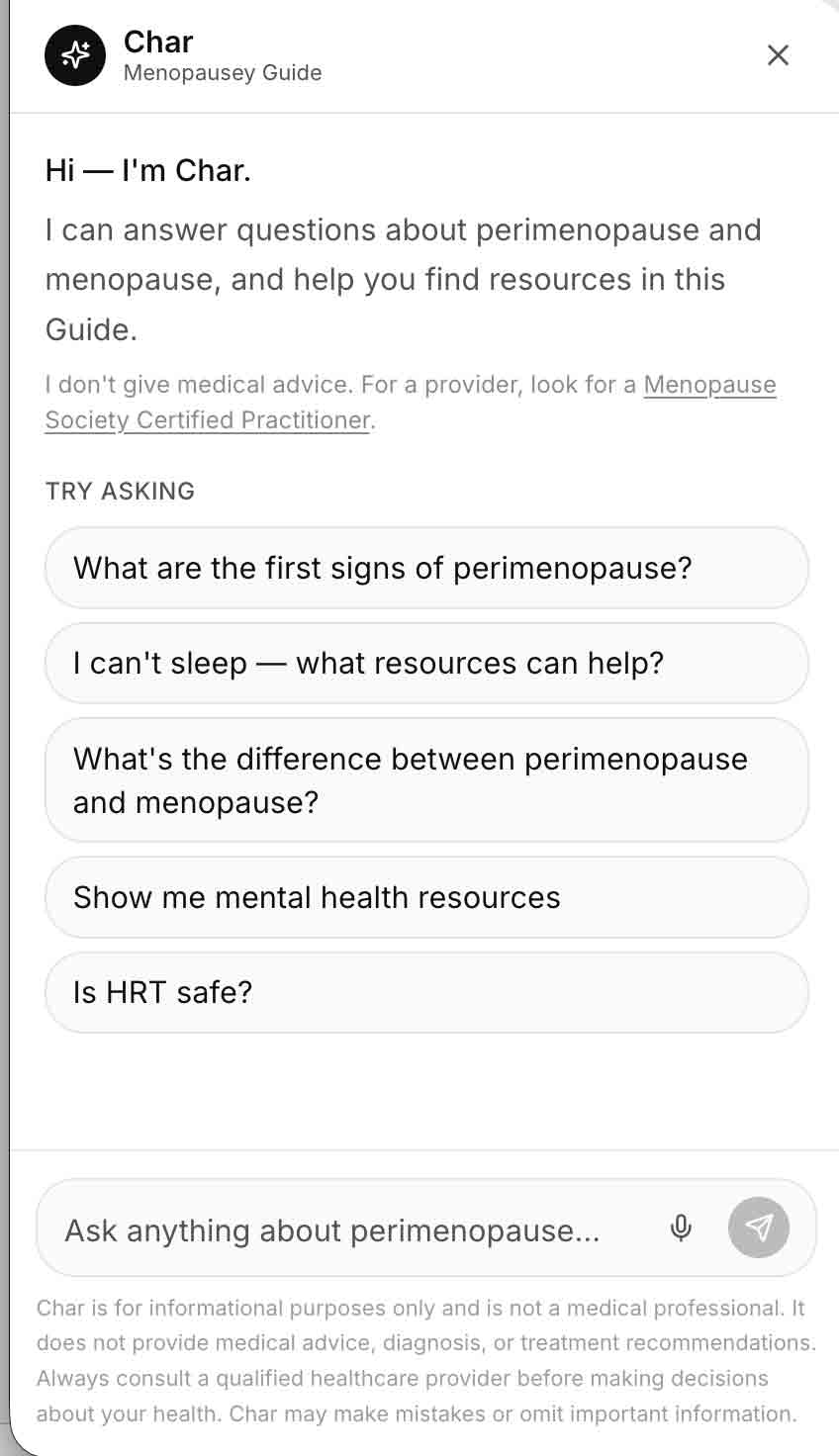
voyage-3) turns resources into embeddings. When a question is written in everyday language, the search matches it by meaning, not just keywords. - AI: Anthropic Claude through the Vercel AI SDK and the Anthropic SDK. Haiku 4.5 handles most tasks, including the "Char" chat assistant, and Sonnet 4.6 handles the heavier analysis.
- UI: Tailwind CSS v4, shadcn/ui (built on Radix), Lucide icons and Geist fonts. Charts on the Market Intelligence page use Recharts, and TanStack Virtual keeps the 1,100+ resource list fast.
- Abuse protection: rate limiting with Upstash Redis, which falls back to an in-memory limiter if Redis isn't available.
- Analytics: Vercel Analytics, with Google Consent Mode v2 for privacy-respecting consent.
- Testing: Vitest
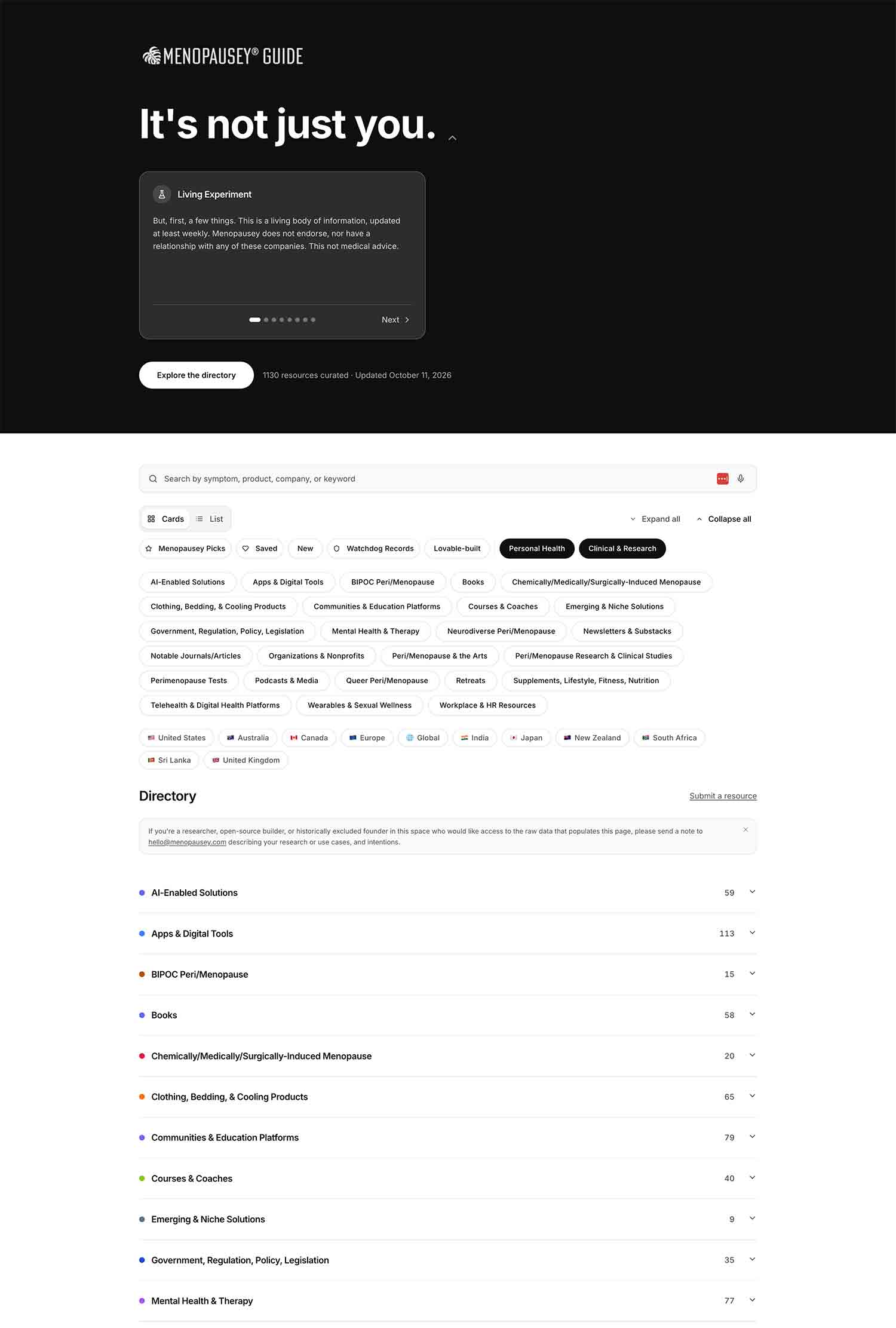
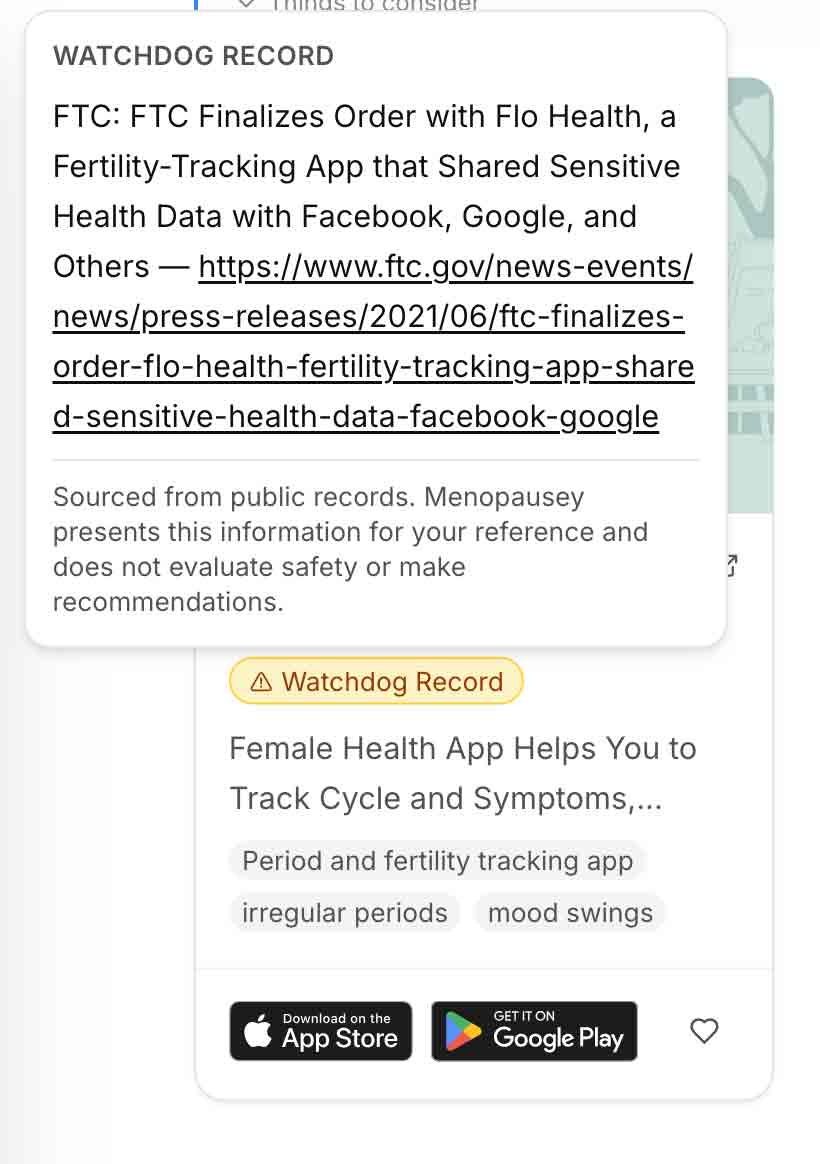
While filters and search options are extensive, one of the most important features, in my opinion, is the ability to see which products have associated watch dog records.
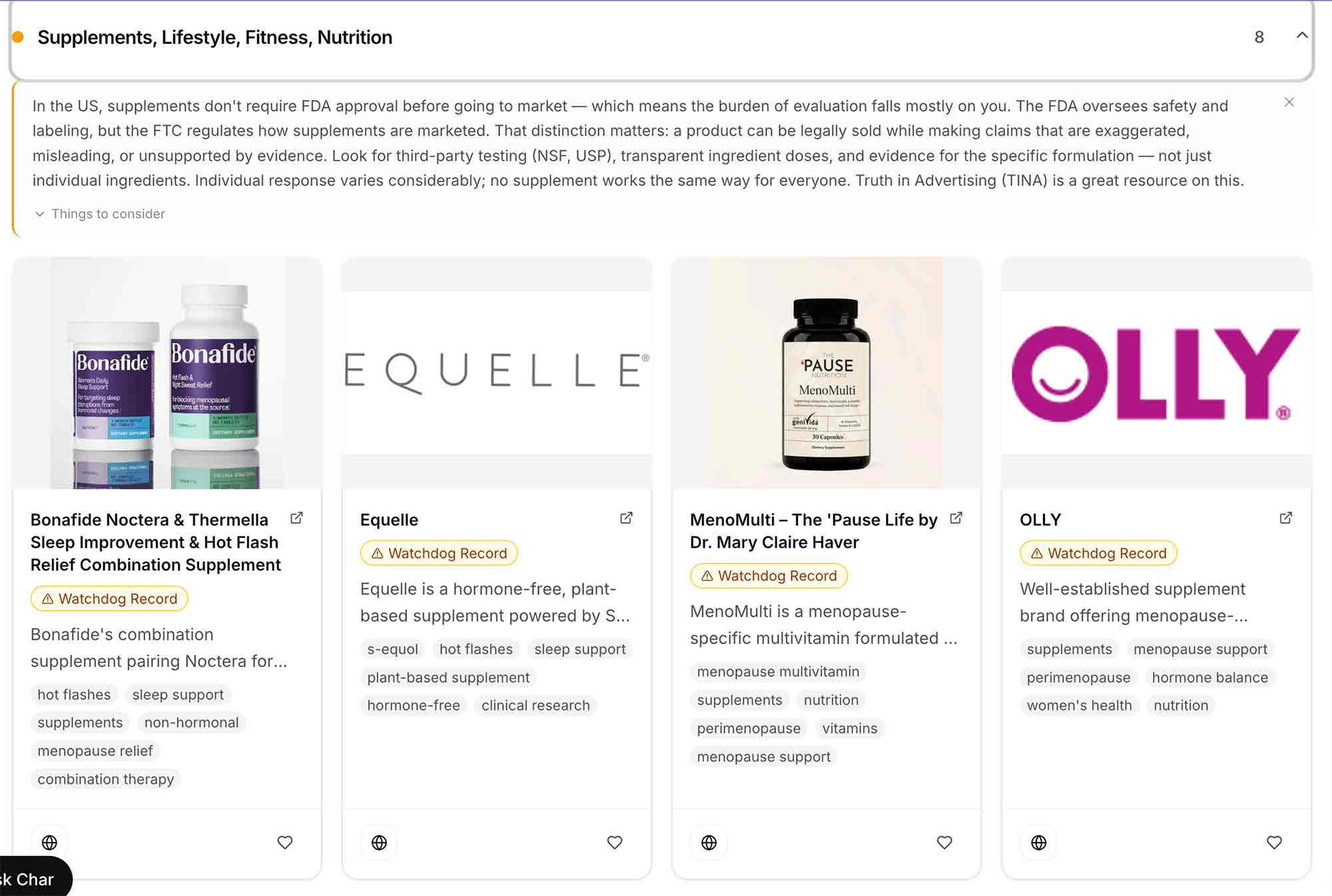
This is a comprehensive and always evolving scan of all of the types of things being sold to "improve" the peri/menopause experience. And while curated, over time, I decided to make this more of an educational resource than a recommended solutions resource.
That means some of these items are sketchy, some are borderline predatory, and many are not supported by science.
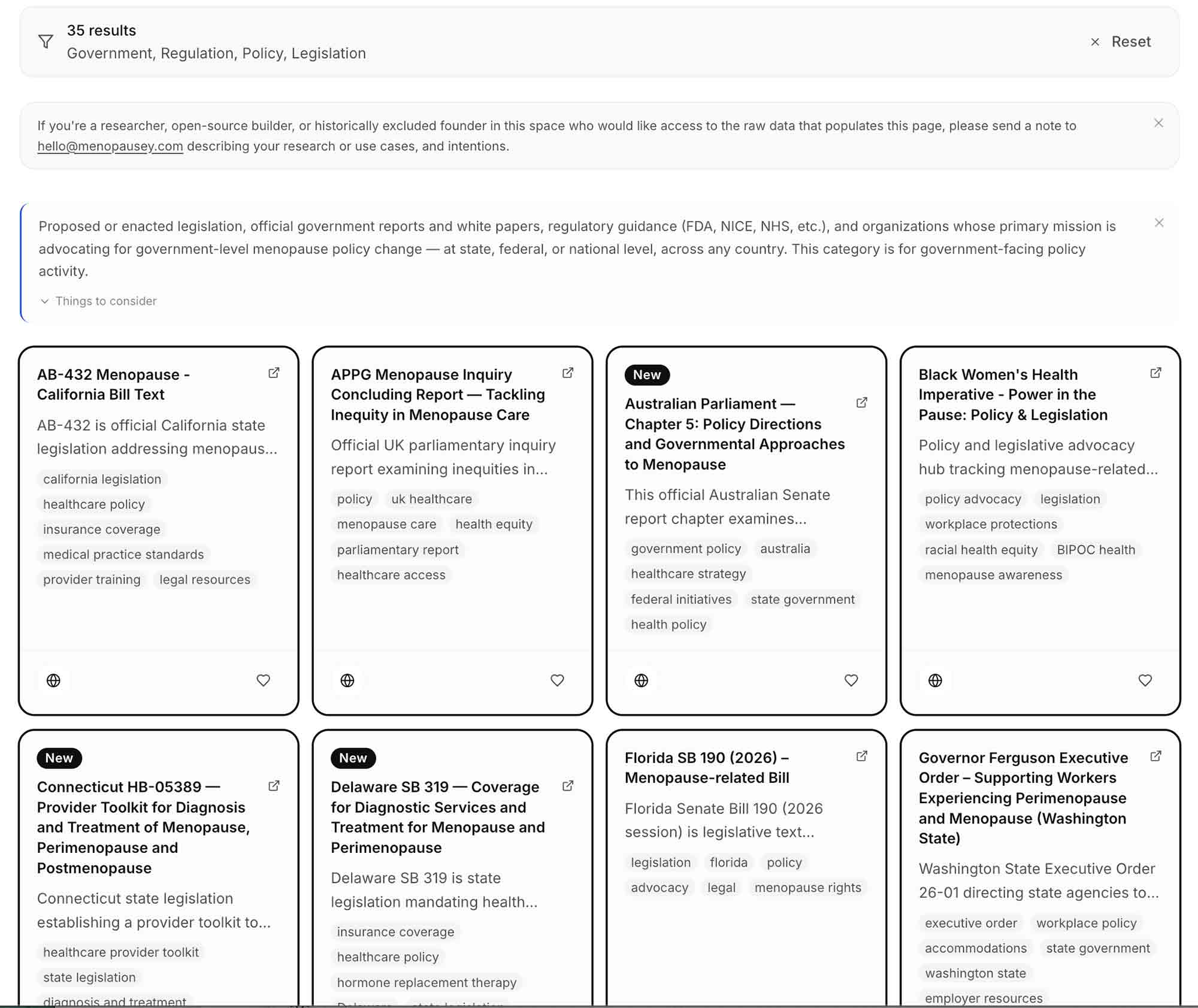
One of my other under the radar favorite sections is the Government, Regulation, Policy, Legislation area.
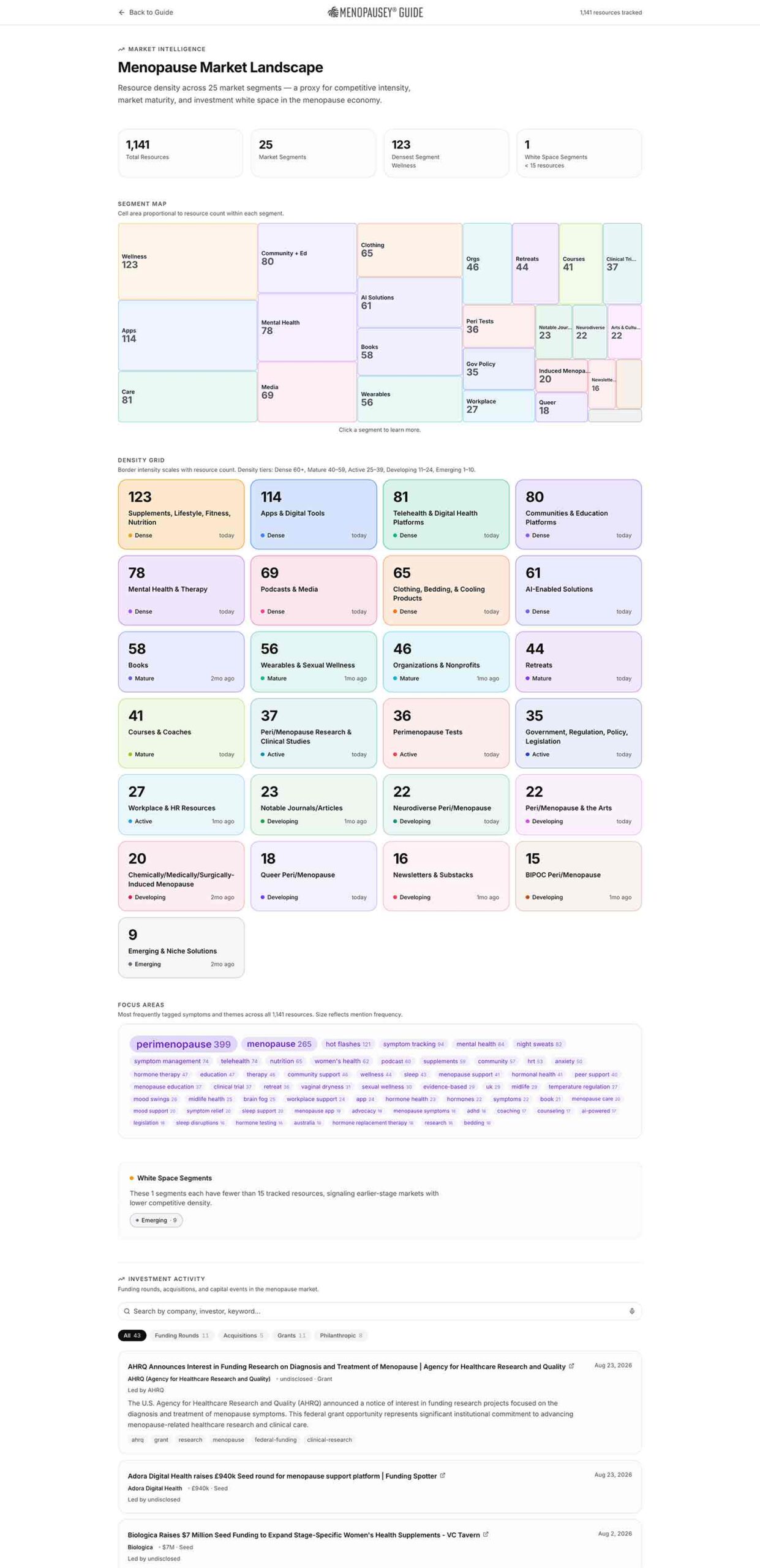
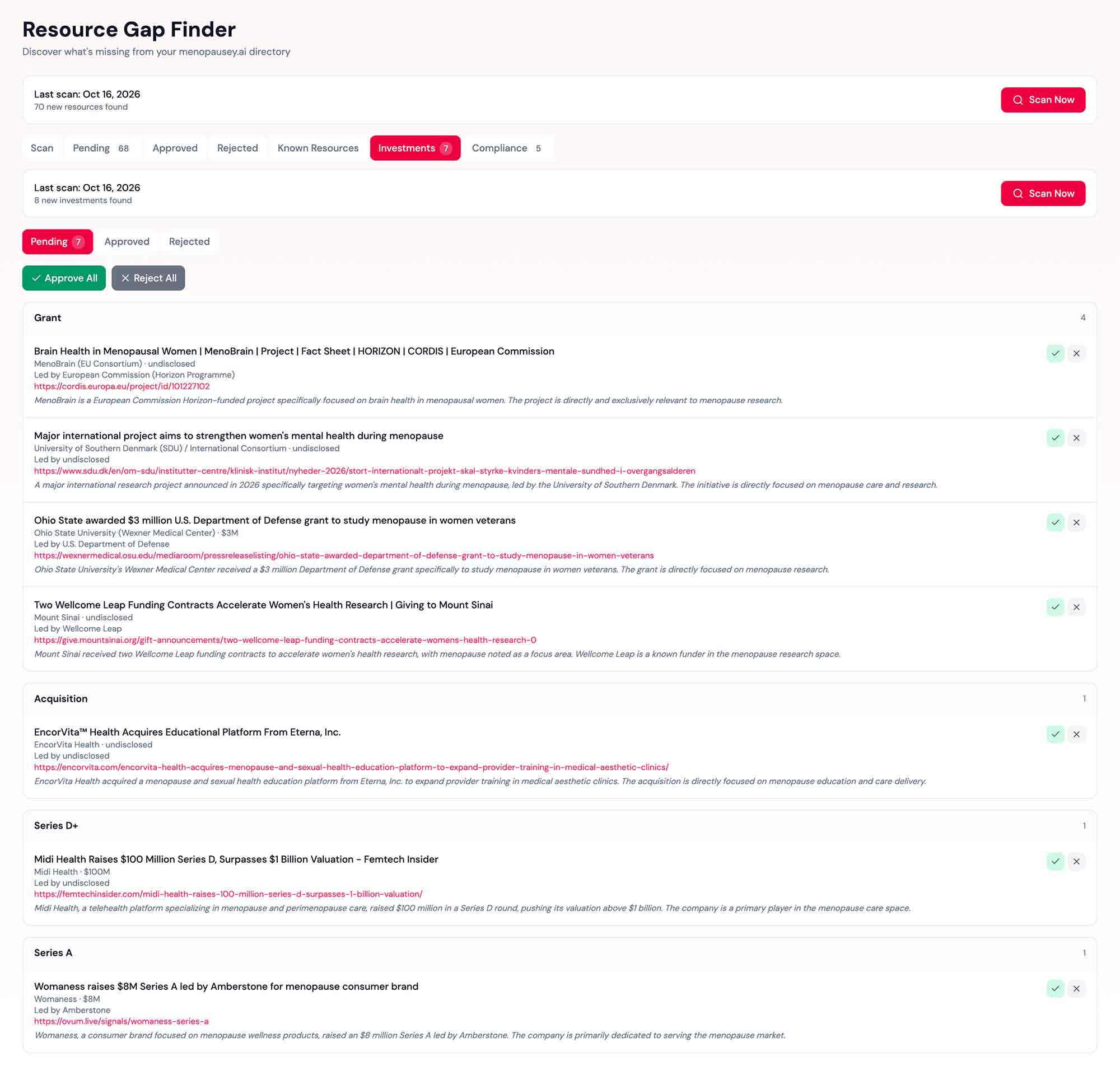
As I collected more and more resources, I realized a market view might be of use to fellow founders and investors, so I built this to track category counts and density, and where money is going.
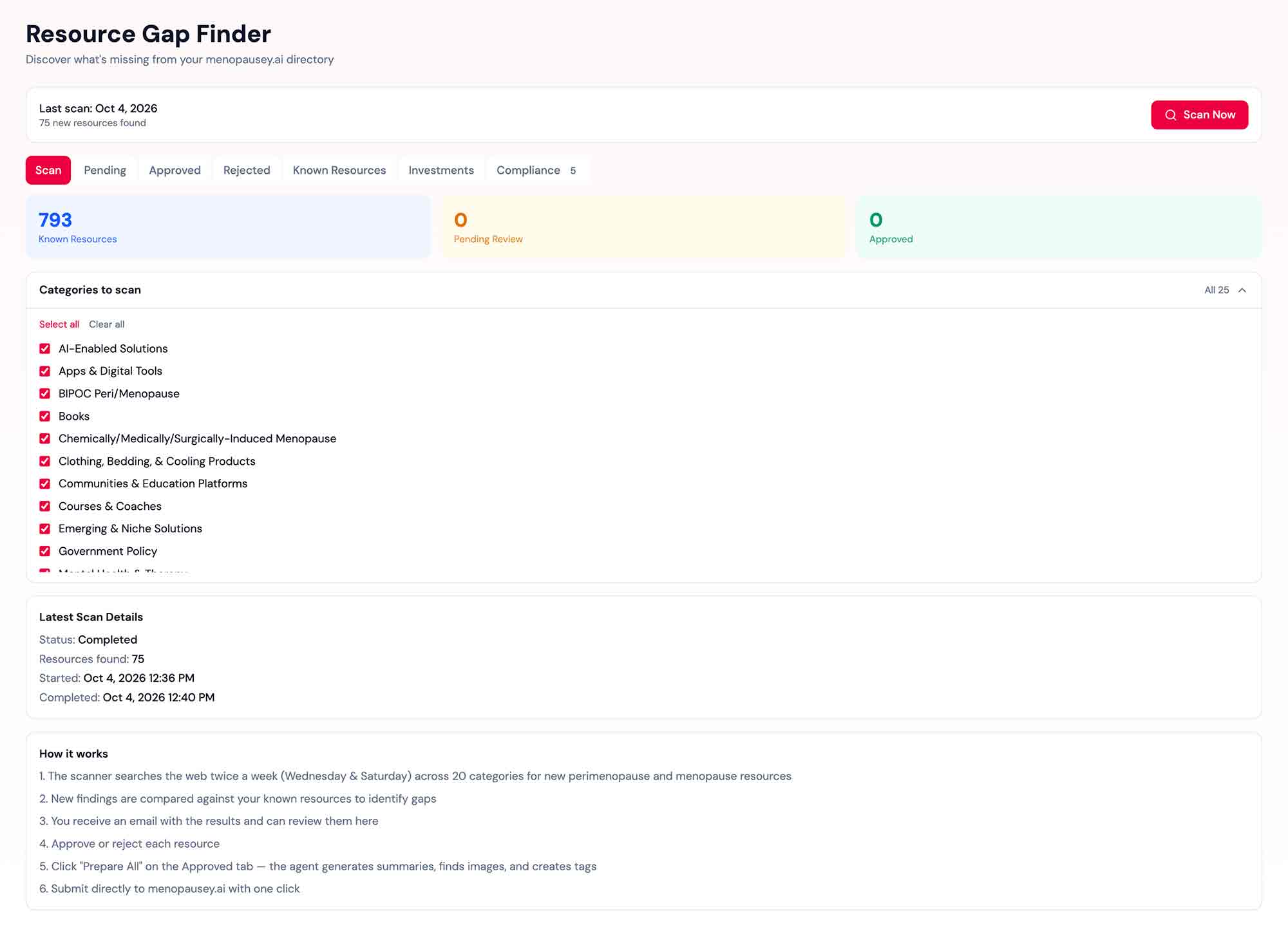
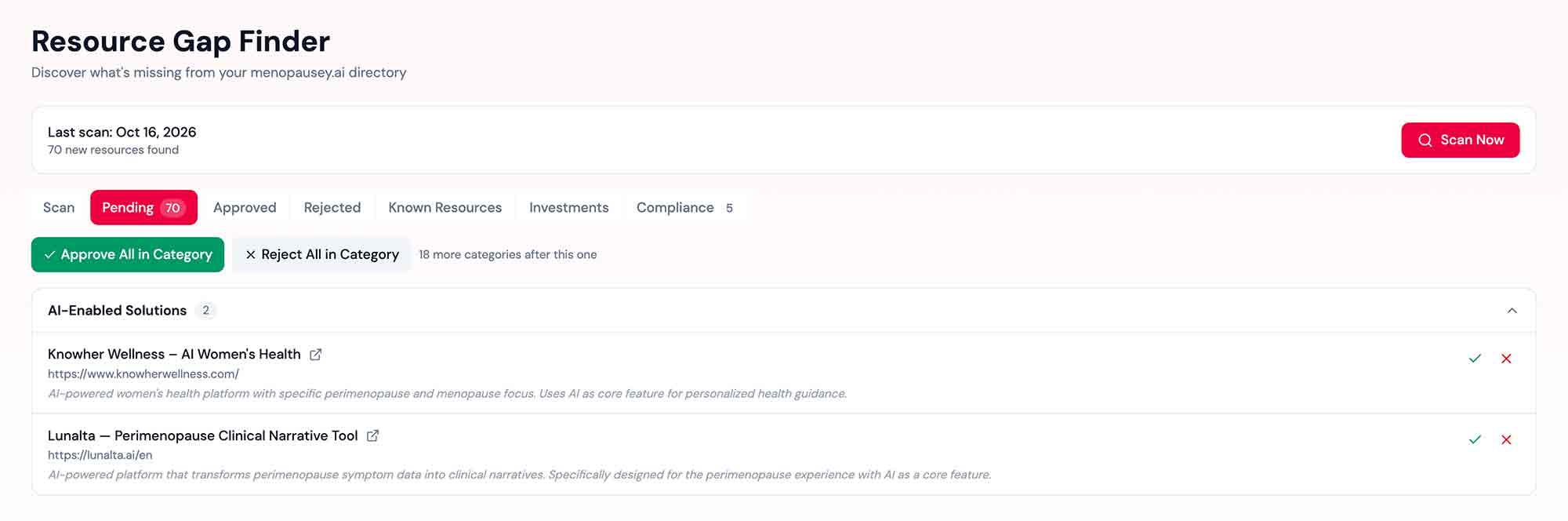
All of this is supported by an administrative back end system I run locally that helps with the curation process. When my local server is running, scans occur twice a week on a schedule. Otherwise, I trigger them on demand.
The Resource Gap Finder surfaces new items via exa.ai (56 queries across 25 categories), runs a duplicate check, and presents them in the UI for me to review, approve, and submit to the database.
Tech Stack (list generated by Claude Code)
- Runtime: Bun, which runs the server, installs packages, runs tests and bundles the code.
- Backend: Hono, a lightweight TypeScript web framework, serving a small API.
- Frontend: React 19 with Vite and Tailwind CSS v4, plus TanStack Query for data fetching and Lucide icons.
- Database: SQLite through Drizzle ORM, using Bun's built-in SQLite driver. It's a single file on disk, which is all an internal tool needs.
- Web search: the Exa search API finds candidate resources across 25 categories, about 56 searches per run.
- AI: Anthropic's Claude.
- Claude Sonnet reviews every search result in a single batch call, deciding what's a real resource and which category it belongs in.
- Claude Haiku writes summaries and tags for approved resources.
- Duplicate detection: custom TypeScript checks each find against the 1,100+ resources already on menopausey.ai, so mostly new finds reach me.
- Scheduling: node-cron runs the scans automatically twice a week.
- Notifications: Nodemailer emails me when new resources are waiting for review.
- Hosting: Fly.io, in a Docker container that shuts down when idle, with a persistent volume for the database. (I only use this when I travel and usually just run the scanner locally.)
- Live site connection: it reads from the menopausey.ai Postgres database on Neon to check for duplicates. Approved resources go to the live site through its import API.
I first built this using a no-code agent building platform called Dreamer. It worked surprisingly well even though it was in Beta, until the team got acqui-hired by Meta and then shut it down. Fortunately, I was able to export my code files and rebuild the functionality using Claude Code.
It was a sucky, but useful reminder, that any 3rd-party SaaS tool (or model) could evaporate at any time. Recent and related lessons with other tools have reminded me that costs can also go up at any time and without notice. I'd recommend you try to get as much of your workflow and building out of the Big AI products as you can.
Accessibility
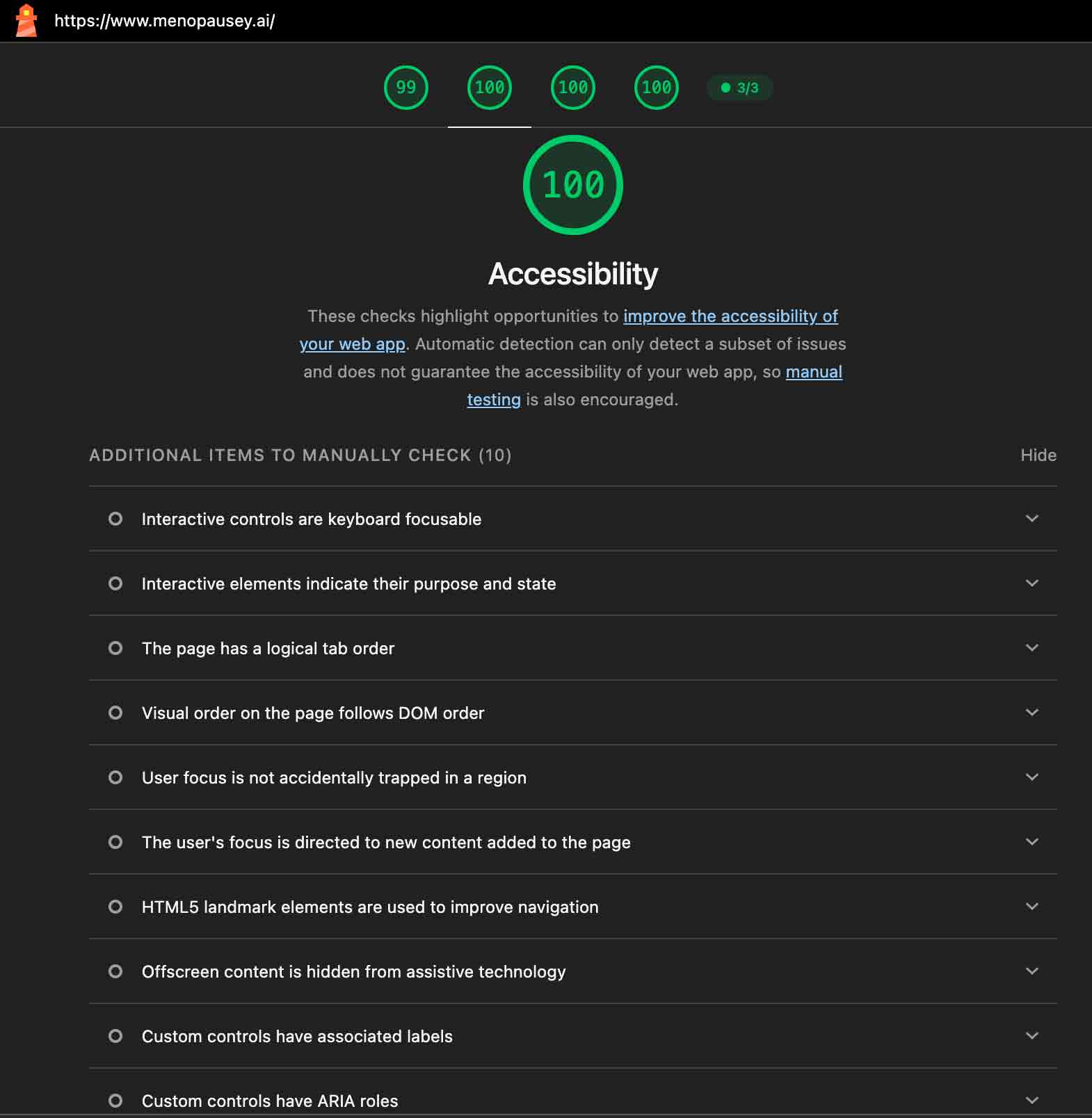
I aim for everything I build to meet Web Content Accessibility Guidelines (WCAG) 2.2. There's no excuse to build inaccessible solutions in this day and age. Run checks using Lighthouse and work with Claude Code (or your tool of choice) to improve your results.
Other Things I Learned and Observed
Paying close attention to the market via this application was incredibly useful as a founder also building in this space (flagship prototype build notes coming soon). It also eventually disheartened me and served as the evidence that I needed to stop trying to commercialize Menopausey.
For a long time, I've watched new vibe-coded apps hit the app stores week over week and they all tout the same features. Many lack transparency. Perimenopausal humans still aren't much better off. I went from being an early pioneer and one of the first building in this space to a copy-cat product. That stung.
While I haven't seen anything as comprehensive as the Menopausey Guide, anyone can build it now, which is both awesome and not awesome. 😉
On Tools
I started building this guide in v0 and eventually shifted my entire workflow into Claude Code in Visual Studio Code. There came a time where trying to troubleshoot in v0 felt super inefficient and I was ready to level up my building game. While I continued to be a v0 champion for a while, after a couple of rounds of billing hiccups, some pretty bad AI-powered support, and a bill increase without notice from $20/month to $30/month, I canceled my subscription. (They did resolve my billing issues.)
Extensibility
I built a strong foundation that will serve me well for any sort of directory solution in the future.